Out now on the App Store
The name, and the whole chart behind it
Your baby's birth star, their full kundali and their stone — worked out on your phone in a moment, for as many people as your family asks, with no fee for each one.
16,423 hand-curated names from five traditions, each with a real meaning. The janma patrika for any birth moment: panchang, both sidereal signs, Rahu and Ketu, the dasha periods and the ratna. And a reading for every day. The names are free, the chart unlocks with one payment, there is no fee per chart, and it all works with the phone in Airplane Mode.
Free to install, with all 16,423 names · the birth chart unlocks once · no subscription · no adverts


The part that was always arithmetic
You should not have to pay for a calculation twice
Getting a janma patrika usually means finding an astrologer, paying a fee and waiting for it. Then the next child arrives, or a cousin asks, or someone wants their own chart checked — and you pay again, for the same work done a second time.
But the chart itself is not a judgement call. The Moon was where it was. Tithi, vara, nakshatra, yoga and karana. Both sidereal signs. Rahu and Ketu. The Vimshottari periods and their dates. The ratna of the ruling planet. Every one of those follows from the birth moment by the same Lahiri ayanamsa the almanacs use — it is a computation, and a phone does it exactly.
So Bothnames does it, and keeps doing it. For your baby, for the next one, for a nephew, for a friend's newborn, for your own birth moment. No fee per chart, no appointment, no waiting and no limit — there is no service behind it to meter and no connection for it to need.
Nakshatra & kundali
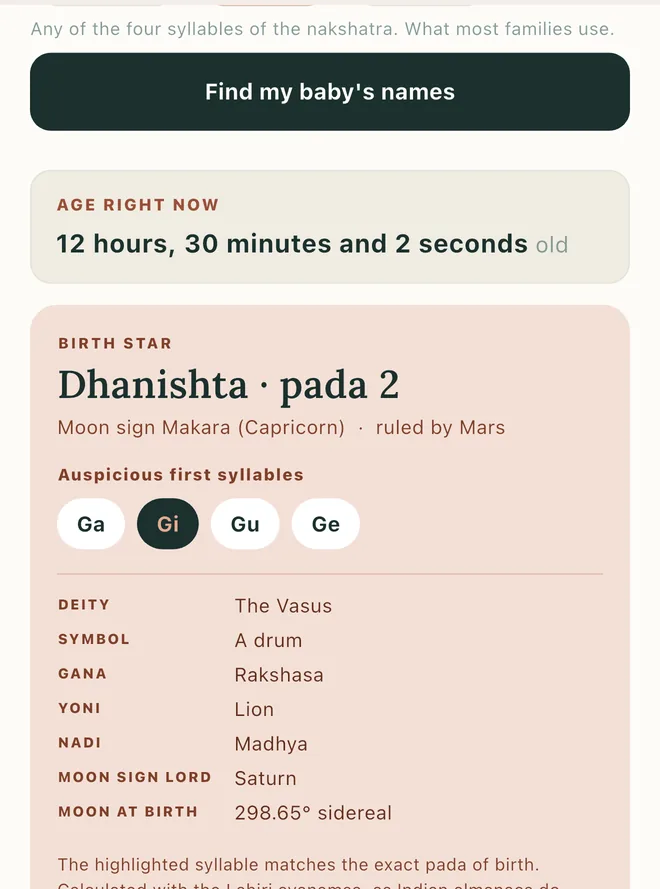
Names for your baby's birth star
For families who name by the nakshatra, Bothnames works out the birth star from the date, time and zone of birth — the real calculation, with the Lahiri ayanamsa, done on the phone.
It gives the pada, the syllables that traditionally begin the name, and the names in the book that start with them.
These are the traditional readings of a moment, not predictions about a child, and the app says so on every screen that shows one.
Janma patrika
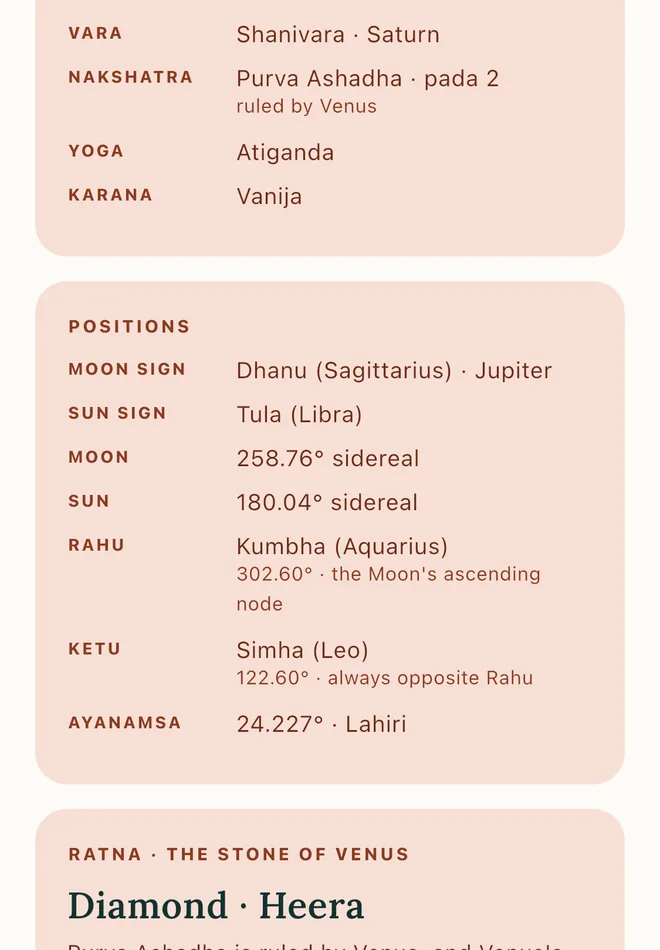
The whole chart, not just the star
The panchang of the day — tithi, vara, nakshatra, yoga and karana. Moon sign and Sun sign, both sidereal. Rahu and Ketu in their signs. Every Vimshottari dasha period with its dates, each opening into its bhuktis.
And the ratna: the stone of your baby's ruling planet, named with the cheaper substitute the tradition accepts in its place — because the tradition is not only for families who can buy a sapphire.
It is the almanac page a family is usually handed on a printed sheet, worked out on the phone with the Lahiri ayanamsa.
Every day, not just the first
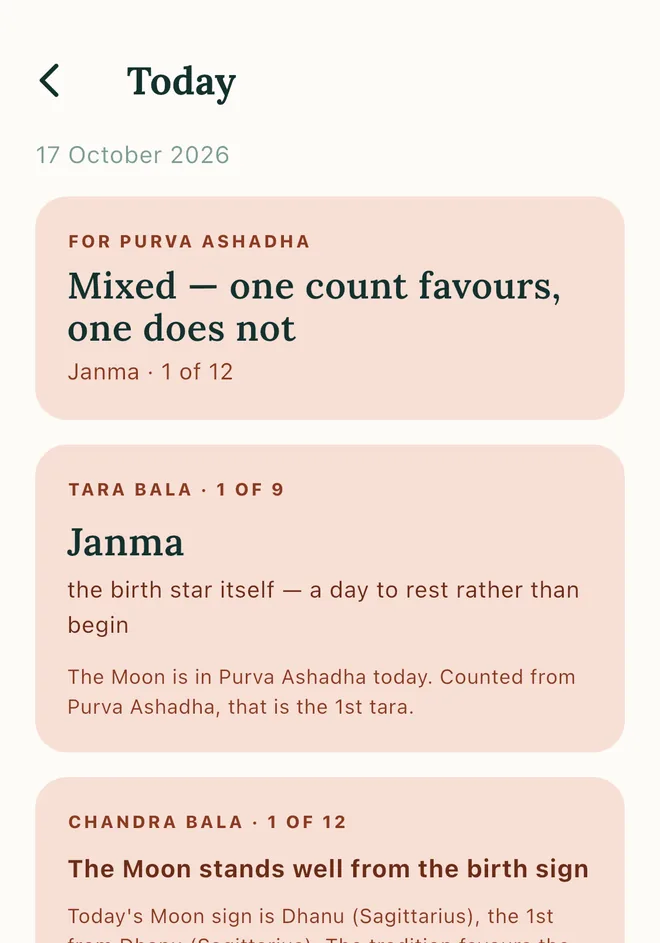
Today, counted from your baby's star
Follow the birth star and each day is read against it — tara bala, the nine-fold count from the birth nakshatra to today's, and chandra bala, the Moon's sign measured from the one it held at birth. That day's panchang comes with it.
As many charts and as many readings as you like, every day, for as long as you own the app. Nothing to unlock, nothing to subscribe to, and no limit on either.
And none of it is downloaded: the reading is worked out on the phone from the date, so it arrives the same on wifi, on a train, or in Airplane Mode.
Pass the phone
Two parents, one phone
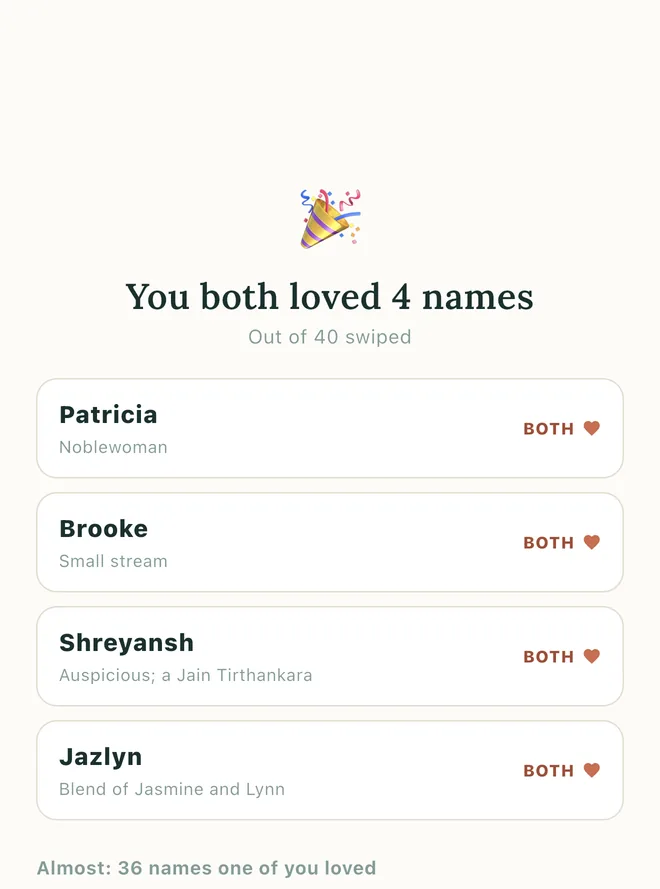
You each swipe the same deck of names in private. Neither of you sees the other's choices until you have both finished — and then the app shows only the names you both liked.
No second purchase, no second install, and nobody has to admit to liking a name out loud before they are ready.
When you are still stuck
A decider, not a longer list
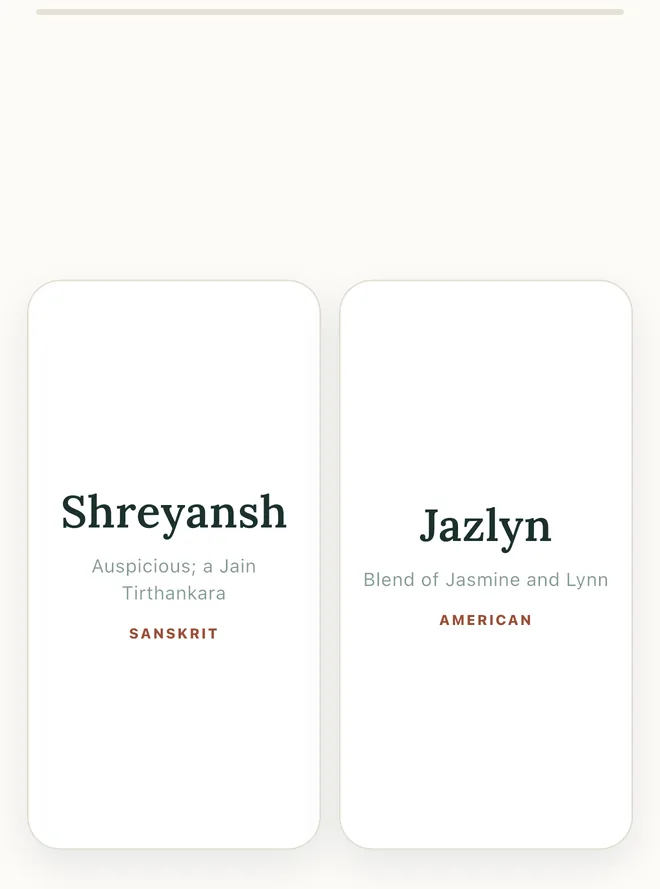
Shortlists grow. This one shrinks: the names you both liked go head to head, two at a time, until one is left standing.
It is the screen no other baby-names app has, and the one couples reach for at eight months.
Five traditions
Curated by hand, not scraped
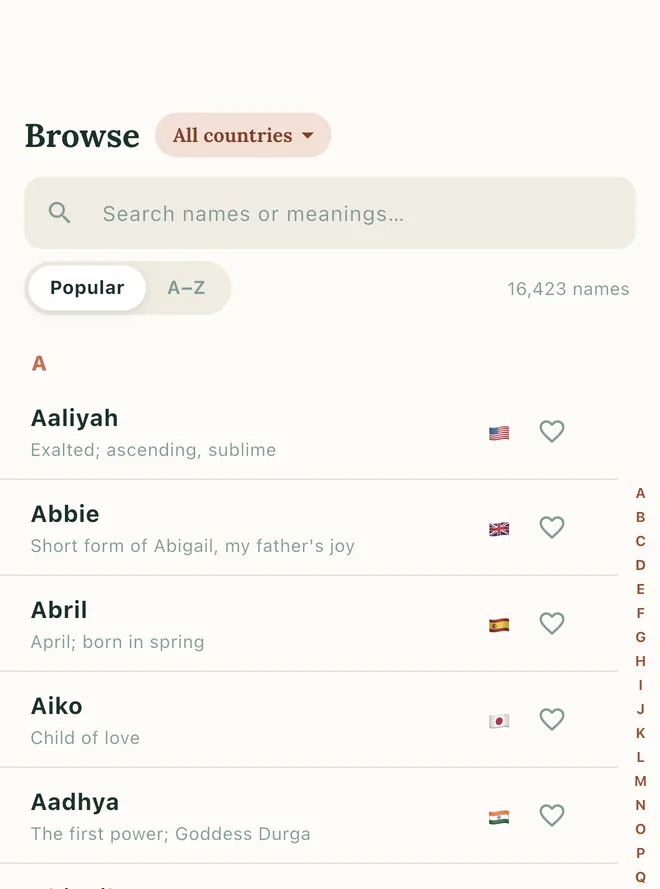
Every entry carries a meaning that can be defended. Where a spelling is shared by two cultures, the app shows both readings rather than pretending there is one.
4,928
India
3,728
United States
2,801
Britain
2,505
Latin America & Spain
2,461
Japan
Nothing leaves your phone
Not a promise. A property of the app.
Bothnames has no internet permission at all — not restricted, not optional. The app is technically incapable of making a network request. Your shortlist, your matches and your baby's birth details stay on your device, and the birth details are not saved even between sessions.
There is no account, no sign-up, no analytics and no advertising. All 16,423 names are there the moment you install it; nothing is held back behind an upgrade.
Out now on the App Store
Free to install, with all 16,423 names from the moment you open it. The full birth chart, the ratna and the daily reading unlock with a single payment — once, never a subscription. iPhone, iOS 15 or later.